
Auto-resolved chains
Click any endpoint. The engine builds the prerequisite chain from your schema and runs it in topological order.
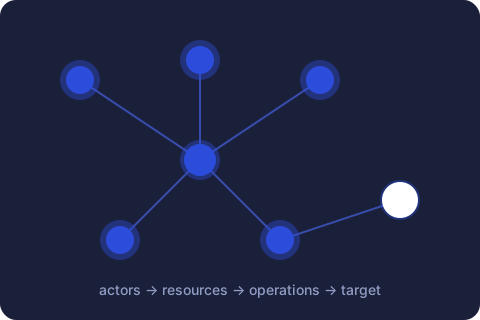
Modern SaaS backends are multi-actor. To test “admin approves a customer refund”, you need to log in as three actors and create six prerequisite records first. ChainAPI treats your API as a dependency graph: define each actor and resource once, then run any endpoint with a single command — the engine auto-resolves the entire chain.
chainapi run refund.approve --project marketplace# resolves: vendor.login → customer.verify_otp →# product.create → product.publish →# order.create → order.pay →# refund.request → refund.approve# 9 steps. 3.4 seconds. Zero copy-paste.Auto-resolved chains
Click any endpoint. The engine builds the prerequisite chain from your schema and runs it in topological order.
Multi-actor first
Admin, vendor, customer, worker — each actor’s auth flow is defined once. No more re-logging in every morning.
One file, every environment
Local, staging, production. Same schema. Switch with --env.
AI importer
Generate a working schema from your OpenAPI spec, Markdown docs, or pasted curl logs in ~5 minutes.
Open core
Apache 2.0 engine, CLI, schema, and desktop. No vendor lock-in.
Local-first
Your project, schemas, and history live on your machine. Nothing forced to the cloud.
# Coming with v1 release. Today: build from source — seebrew install chainapi/tap/chainapi# AppImage:curl -L https://github.com/chainapi/chainapi/releases/latest/download/chainapi-linux-x86_64.AppImage -o chainapichmod +x chainapi# Scoop:scoop bucket add chainapi https://github.com/chainapi/scoop-bucketscoop install chainapigit clone https://github.com/chainapi/chainapicd chainapicmake --preset macos-debugcmake --build --preset macos-debugSee Building from source for the full prerequisites.
| | Postman | Bruno | Insomnia | ChainAPI | |--------------------------------|---------|-------|----------|--------------| | Auto-resolved request chains | ❌ | ❌ | ❌ | ✅ | | First-class actor abstraction | ❌ | ❌ | ❌ | ✅ | | AI importer for any spec | ❌ | ❌ | ❌ | ✅ | | Git-friendly schema files | partial | ✅ | partial | ✅ | | Open source | ❌ | ✅ | partial | ✅ | | Local-first by default | ❌ | ✅ | ❌ | ✅ | | CLI for CI/CD | partial | ✅ | partial | ✅ |
5-minute tour
See ChainAPI run the marketplace sample end-to-end. Take the tour →
Authoring guide
Learn the schema by example. From auth flows to dependency chains. Read the guide →
AI importer
Convert your existing OpenAPI / Postman / curl into a runnable schema. Use the playbook →
Architecture
How the engine resolves chains, caches sessions, and stays Qt-UI-free. Architecture →